
Blackjack basic strategy: the decision chart without magic

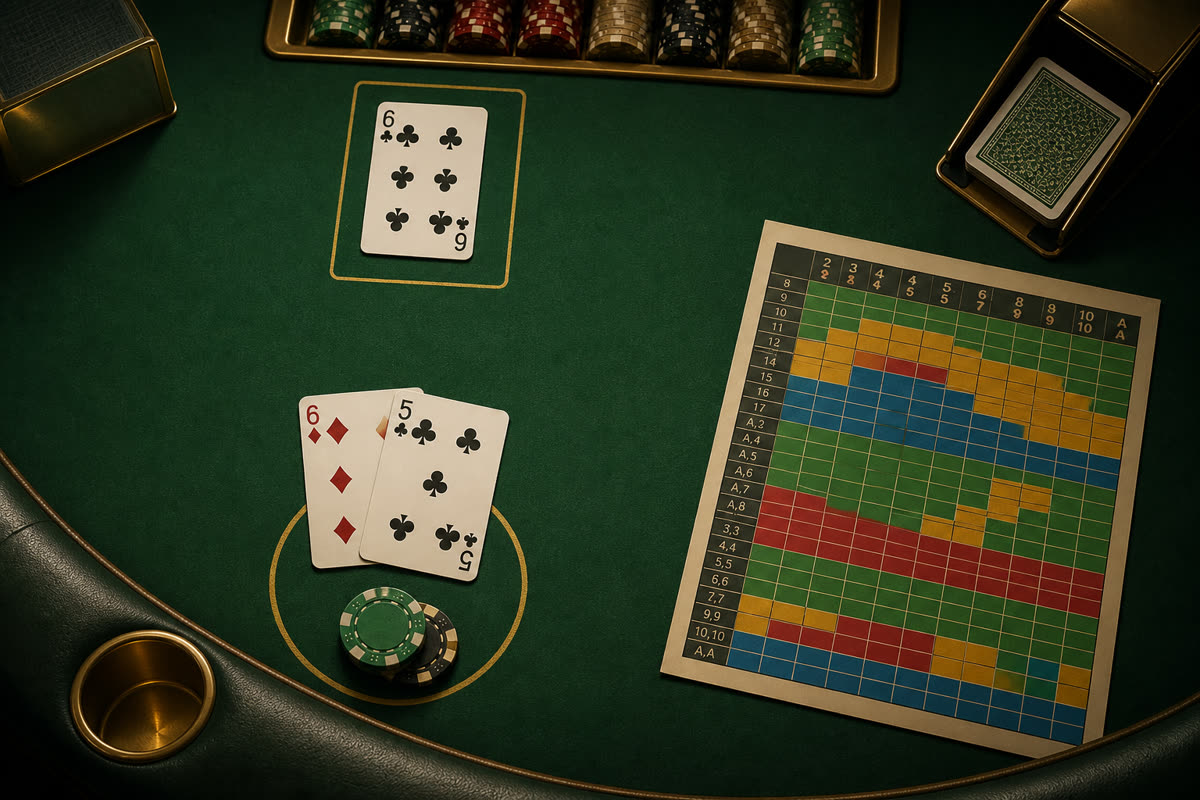
Basic strategy is not a vibe. It is a solved map: for every player total against every dealer upcard, one action maximizes expected value. Follow it and you are not beating the house — you are refusing to donate extra edge on top of the built-in rake of the game.
Chart zones at a glance
What the chart is actually optimizing
Blackjack is finite. With a known deck composition, each (your total, dealer upcard) pair has a mathematically best action. Basic strategy is that answer table, averaged over millions of simulated hands. You are not predicting the next card — you are picking the line that wins or loses the least over thousands of repetitions.
Hard totals: where most money leaks
The painful band is hard 12 through 16 against a strong dealer card. Standing on 16 vs 10 feels like surrendering; hitting feels like suicide. The chart says hit — because standing loses about 74% of those hands and hitting loses about 62%. That 12-point swing is why discipline beats courage here.
- Never stand on hard 16 vs 7–A — hit every time.
- Stand on hard 12–16 only when the dealer shows 2 through 6 (weak upcards).
- Double on hard 11 vs dealer 2–10; on hard 10 vs 2–9.
- Never take insurance — it is a side bet with roughly 7% house edge, not protection.
Soft hands and pairs: the free equity
An ace counted as 11 changes everything. Soft 18 (A-7) looks strong until the dealer shows 9, 10, or ace — then you hit, because standing is a slow bleed. Pairs are split machines: 8,8 always (two eights lose; two chances at 18 do not), A,A always, 10,10 never. 9,9 splits vs 2–6 and 8,9 but stands vs 7, 10, A.
I remember when I «read» the dealer instead of the chart
I remember a session where I stood on 16 vs 10 three hands in a row because the dealer «looked cold.» He flipped 20, 19, 20. I lost $120 in twelve minutes on a $20 table — not because blackjack is rigged, but because I paid a ~12% tax on top of the normal edge by treating pattern-spotting like poker reads. After that I taped a chart to my monitor for two weeks. Boring. Profitable.
Bankroll framing: chart compliance as a metric
Track deviation count, not just win/loss. If you play 200 hands and deviate 10 times, you have added roughly 1–3% effective house edge on those spots alone. Set a stop-loss in units, not dollars — 50–100× minimum bet for recreational play, 200× if you double after losses (which the chart does not recommend, but humans do anyway).
Print the chart, run it for a week on NUTS POKER blackjack tables, then internalize the five zones above. If you are still guessing on hard 16 vs 10, the problem is not the game — it is that you are playing poker instincts at a math table.


